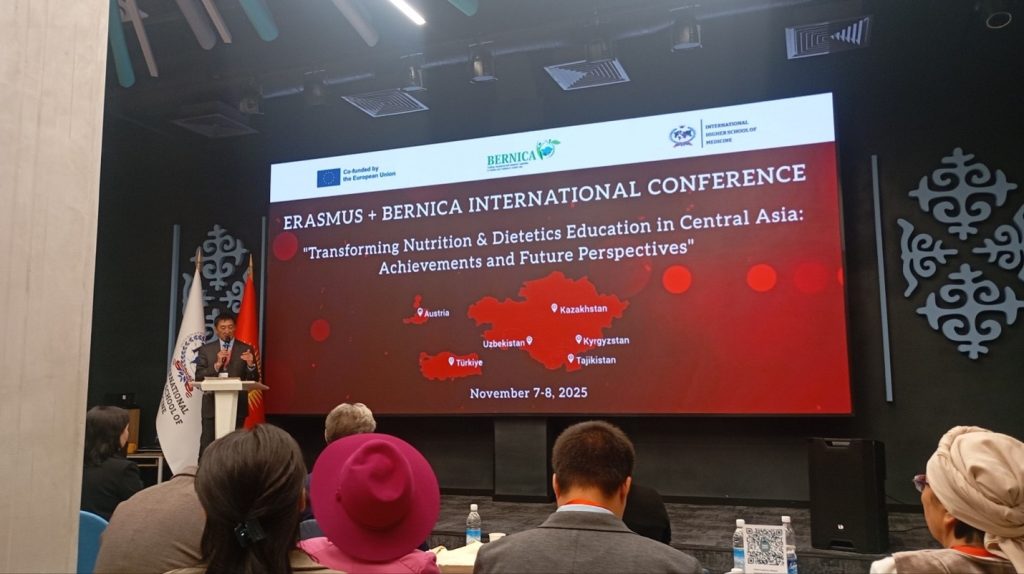
On 7 November, the BERNICA International Conference commenced under the title “Transforming Nutrition & Dietetics Education in Central Asia: Achievements and Future Perspectives.”
The international conference commenced with a series of welcoming remarks delivered by distinguished representatives of partner institutions and national bodies:
- Prof. Stalbek M. Akhunbaev, Rector of the International Higher School of Medicine (IHSM), provided the official welcome on behalf of the host institution.
- Dr. Nurlan K. Omurov, Deputy Minister of the Ministry of Science, Higher Education and Innovation of the Kyrgyz Republic, extended greetings on behalf of the Ministry.
- Dr. Bubuzhan K. Arykbaeva, Deputy Minister of the Ministry of Health of the Kyrgyz Republic, conveyed the Ministry’s official greeting and support for the event.
- Ms. Maria-Sol Dominguez-Parrado, Representative of the EU Erasmus+ Programme Office, delivered welcoming remarks on behalf of the European Union.
- Ms. Gulnara R. Isaeva, Head of the National Erasmus+ Office in Kyrgyzstan, expressed greetings and highlighted the importance of regional collaboration within Erasmus+ initiatives.
The opening session continued with the BERNICA Project Coordinator, Dr. Kenesh Dzhusupov, who presented an introductory address and provided an overview of the conference objectives.
The keynote session, titled “Transforming Medical Education through Nutrition & Dietetics Integration,” was delivered by leading international experts:
- Dr. Manuela Konrad, Fachhochschule Joanneum, Austria;
- Dr. Indrani Kalkan, Istanbul Medipol University, Türkiye.
Their presentations highlighted contemporary approaches to embedding nutrition and dietetics within medical education, emphasizing evidence-based practice, interdisciplinary training, and the need for harmonized regional standards.
After the coffee break, the conference proceeded with Session 1, dedicated to a structured presentation of the principal results of the Erasmus+ BERNICA project.
This session offered a detailed and analytical review of the project’s progress, outcomes, and regional impact.
The presentations were delivered by representatives of the International Higher School of Medicine (IHSM), Kyrgyz Republic:
Dr. Dzhusupov provided a broad summary of the project’s accomplishments, highlighting advancements in curriculum development, establishment of digital nutrition laboratories, and capacity building across partner universities. He emphasized strengthened regional collaboration and improved academic standards in nutrition and dietetics education.
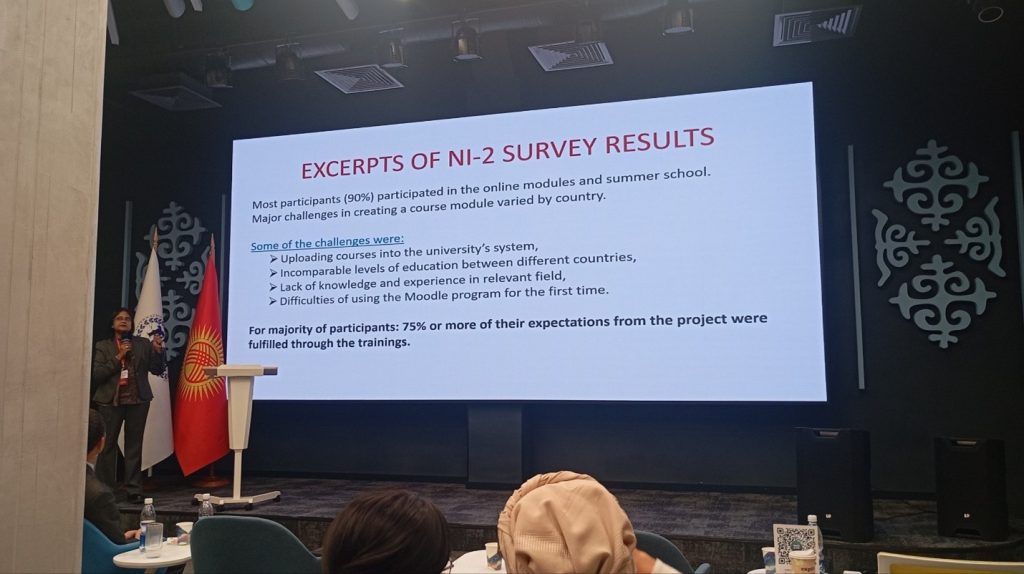
Dr. Lim presented a detailed statistical evaluation of the project’s effectiveness, including quantitative indicators on student learning outcomes, staff training, and institutional modernization. Her analysis demonstrated significant increases in academic performance, digital competency, and inter-institutional cooperation.
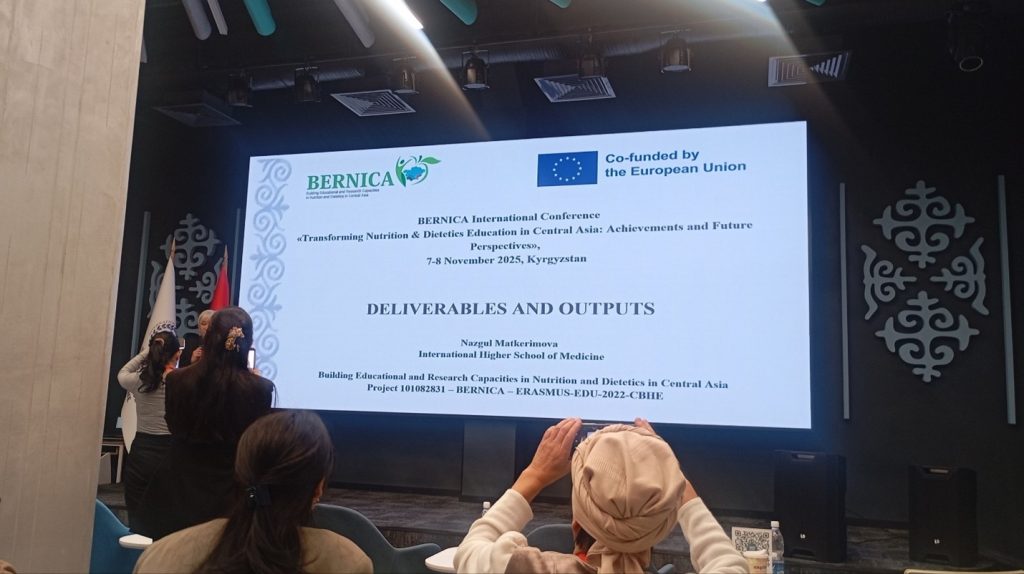
Dr. Matkerimova outlined the full set of project deliverables, such as updated MSc curricula, teaching materials, laboratory protocols, quality assurance tools, and dissemination reports. She underscored how each output aligns with European standards and contributes to long-term sustainability of nutrition education in Central Asia.
Following the lunch break, the conference continued with Session 2, focused on the outcomes of curriculum development within the BERNICA project.
This session highlighted the progress made in harmonizing academic programs across partner universities and integrating modern educational standards into nutrition and dietetics training.
Representatives of Tashkent State Medical University introduced the newly developed shared modules designed for partner institutions. The presentation emphasized the alignment of course structures, learning outcomes, and digital teaching materials across Central Asian medical universities.

After the coffee break, the conference continued with Session 3, dedicated to presenting the capacity-building outcomes achieved throughout the project. This session focused on institutional strengthening, professional development, and improvements in educational infrastructure across partner universities.
- Equipment and Infrastructure Improvements
Presenter: Prof. Karlygash Toguzbaeva, Kazakh National Medical University, Kazakhstan. Prof. Toguzbaeva highlighted the modernization of laboratory facilities and classrooms enabled through the project, including the acquisition of advanced nutrition analysis equipment and digital learning tools. She emphasized how these improvements enhance practical training, research capacity, and the overall quality of teaching. - Professional English Language Enhancement Results
Presenter: Dr. Aizhan Omurova, Osh State University, Kyrgyz Republic
Dr. Omurova reported on the achievements of the professional English language enhancement program, noting increased proficiency among faculty and students, improved participation in international conferences, and strengthened ability to engage with global scientific literature. She also discussed the development of English-medium teaching materials and interactive learning resources.
The second day of the conference focused on the strategic dimensions of the Erasmus+ BERNICA project, with particular emphasis on quality assurance, sustainability, and long-term policy implications for nutrition and dietetics education in Central Asia. Throughout the day, participants examined institutional progress, reviewed evaluation mechanisms, and discussed approaches to ensuring the continuity and scalability of project outcomes beyond the project period.
Session 4 was dedicated to reviewing the quality assurance (QA) mechanisms established within the Erasmus+ BERNICA project and assessing their alignment with international standards. The session provided an analytical overview of internal QA methodology and the outcomes of the external audit conducted across partner institutions.
QA Methodology Presentation
Presenter: Dr. Khuseyn Nazarzoda, Avicenna Tajik State Medical University (Tajikistan). Dr. Nazarzoda delivered a comprehensive presentation outlining the QA methodology developed and implemented as part of the project.
External Audit Results
Presenter: Mr. Shaten Toktogaziev, Kyrgyz Republic
Mr. Toktogaziev presented the results of the external audit carried out to assess institutional performance and project implementation quality.
A short coffee break provided an opportunity for participants to exchange reflections on the morning discussions and to further engage in informal academic dialogue. Following the break, the conference proceeded with Session 5.
Session 5: Innovation in Teaching and Learning — Research Capacity Development
Session 5 focused on pedagogical innovation and the strengthening of research capacity within partner institutions. Presenters highlighted new instructional approaches, digital learning tools, and collaborative scientific achievements generated through the BERNICA project.
Innovative Learning Scenarios (ILS) Showcase
Presenter: Dr. Rustam Nazarzoda, Khatlon State Medical University (Tajikistan)
Dr. Nazarzoda showcased a series of Innovative Learning Scenarios (ILS) developed to support interactive, student-centered teaching in nutrition and dietetics.
Research Outcomes and Publications
Presenter: Prof. Roman K. Kalmatov, Osh State University (Kyrgyz Republic)
Prof. Kalmatov presented the major research outputs produced under the project, noting the significant increase in collaborative scientific activity among partner universities.
A lunch break was provided following the completion of the previous session, offering participants an opportunity to engage in informal discussions, reflect on the morning presentations, and exchange insights on institutional practices and regional collaboration.
Session 6 focused on long-term sustainability and strategic planning for the continuation of the BERNICA project’s achievements beyond the formal project timeline. The panel brought together key academic leaders and project coordinators to discuss structural, policy, and organizational measures required to ensure enduring impact.
Session 7 focused on examining the broader policy implications of the BERNICA project and its potential impact on national regulatory frameworks within the higher education sector across Central Asia. The session emphasized how project outcomes contribute to shaping long-term educational reforms and harmonizing regional standards in nutrition and dietetics.
The conference concluded with a formal Closing Ceremony, during which representatives from all partner institutions delivered their final remarks. Speakers reflected on the collective achievements of the Erasmus+ BERNICA project, emphasizing the importance of sustained regional cooperation, continued capacity building, and the long-term impact of the project on nutrition and dietetics education in Central Asia.
Institutional representatives expressed their appreciation for the collaborative efforts demonstrated throughout the project cycle and highlighted the meaningful progress made in curriculum modernization, quality assurance, research development, and international networking.
The ceremony concluded with the certificate and award distribution, led by Dr. Kenesh Dzhusupov, recognizing faculty members, project coordinators, and participating universities for their contributions and active engagement. The awards served not only as acknowledgment of individual achievements but also as a symbol of the shared commitment to advancing nutrition science and educational excellence across the region.


